Funded by UK GovernmentBuilding STEM ecosystems in post-industrial England: Ashfield STEM Boost
Ashfield, Nottinghamshire · 2025–2026 · Commissioned by Ashfield District Council, East Midlands Combined County Authority · UK Shared Prosperity Fund, HM Government
150+
Professionals Trained across 11 organisations
~250
Stakeholders Engaged across private and public sector
600+
Individuals Reached in schools, careers organisations and VCSE’s
30+
Tangible opportunities unlocked including placements brokered with Jaguar-Landrover
All UKSPF targets met, with 8 of 10 indicators overdelivered over 6 months. Strategy, programme design, delivery and capacity building — end-to-end by TTC, engineered for impact beyond the contract.
Context: Ashfield is among the English districts where the long tail of deindustrialisation continues to shape outcomes for young people: lower progression into further and higher education, high benefit claimant numbers, weaker employer–education linkages, and limited exposure to a rich regional STEM economy with significant unfilled vacancies. The Council's challenge was layered: a place where aspirations needed raising, where the family unit shapes a young person's sense of what is possible as much as the classroom does, and where schools, employers and community actors — willing in principle — did not yet have a shared starting point, a current evidence base, and the relationships that turn good intent into live opportunities. This was the Council's commissioning challenge, and it shaped how we scoped the work.
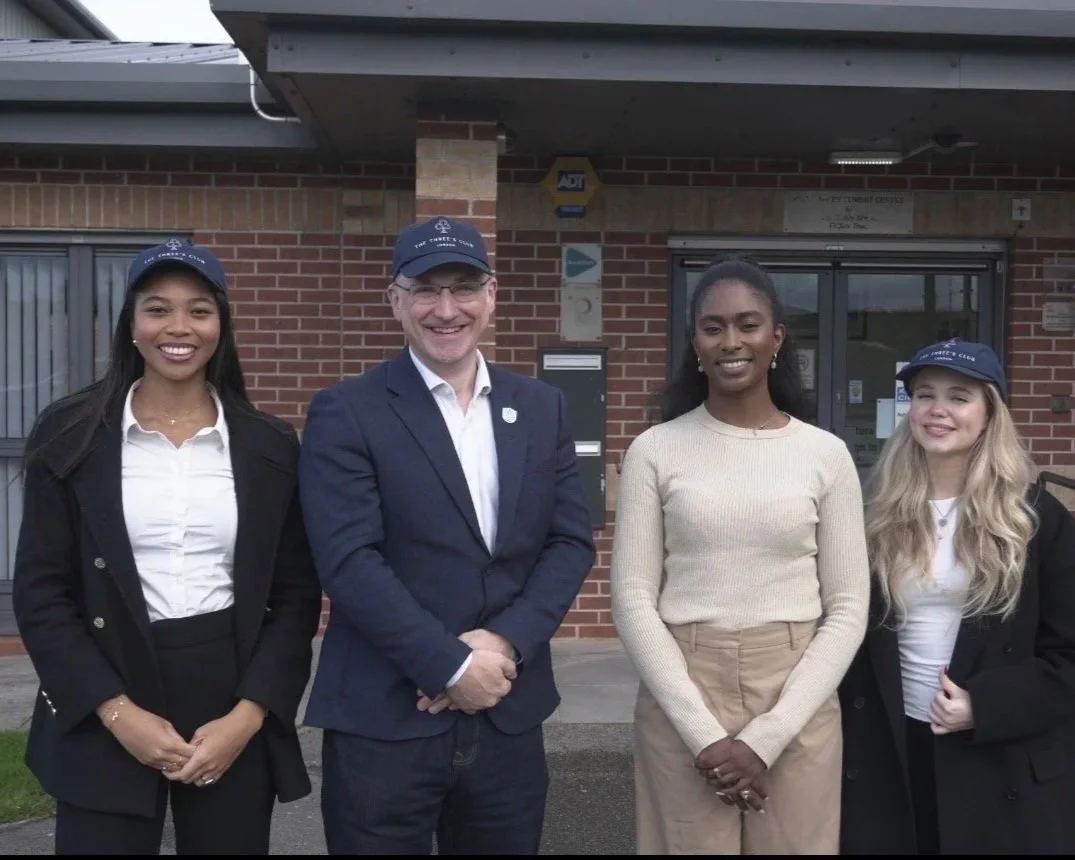
L-R: Felicia Tchen (Co-founder, TTC), Councillor Matthew Relf (Ashfield District), Chelsea Austin-Ajaero (Co-founder, TTC), Anastasiia Talieva (Intern, TTC)
TTC owned the full arc — strategy, programme design, delivery and capacity building.
TTC's diagnostic surfaced the gap that conventional intervention had missed. We analysed labour market data, education progression statistics and the regional employer base, and synthesised the findings into clear insights that elicited change at the practitioner level — many of the educators we worked with were not aware of the scale of the problem in their own district until we evidenced it, just as many of the employers were not aware of how to access the talent pipeline sitting on their doorstep. Surfacing both sides of that information failure gave us the design brief for an evidence-based, research-grounded programme calibrated to the district's specific context: high concentration of regional STEM employers, persistent vacancy gap, and a workforce of educators ready to act once given the data, the tools and the access. We co-created solutions with the existing local partners, working with and not on them.
Programme design. Two integrated pillars, calibrated to the district's specific context. The first focused on equipping educators, careers professionals and employability staff with the tools, skills and confidence to guide students and jobseekers into STEM. The second focused on raising aspirations within and beyond the school gates and creating a live ecosystem of information and opportunity exchange, strengthening links between schools, employers, further education, public-sector stakeholders such as the Department for Work and Pensions, and community organisations across the district.
Delivery. Across the compressed 6-month contract period, we reached 600+ individuals, engaged ~250 stakeholders across the district's institutional landscape, and trained 150+ professionals in 10+ organisations across primary and secondary schools, further education, public sector bodies and VCSEs. We created a pipeline between school and industry with work experience placements, insights days, mentorship opportunities and employer-school engagements, including with the likes of Jaguar-Land Rover and the University of Nottingham. We also delivered a series of flagship “STEM Connect” professional networking events with a total of 200+ attendees.
Reach: 80% of Ashfield's wards and stakeholders drawn from 4 surrounding counties, positioning Ashfield as a regional STEM hub.
Legacy: We did not exit at delivery, the relationships, the re-activated East Midlands STEM Ambassador network, the trained cohort and the evidence base — stakeholder maps, ward-level analysis, evaluation data — remain embedded in Ashfield, equipping the Council and the East Midlands Combined Authority with strategic infrastructure for successor bids and place-based strategy.
Ashfield STEM Boost is representative of how The Three's Club operates: place-based, evidence-led, end-to-end. We take the diagnostic seriously, design the intervention to the place rather than to a template, deliver against contract, and engineer the legacy so the change outlasts our presence. It demonstrates TTC's positioning: not a delivery contractor, but a cultural strategy practice that leaves structural change behind.
Work with us
Ashfield STEM Boost is one project among many. Our work spans education, culture and place — public-sector commissioners, cultural institutions and foundations, language and cultural diplomacy bodies, museums and heritage organisations, education providers, and corporate partners building social impact and ESG-aligned work.
The common thread is how we work, not what we work on. Every engagement is bespoke. We listen first, design to the place and the people, and build the work so the change holds after we leave.
If your organisation is thinking through a challenge where that approach would fit, we would welcome the conversation.